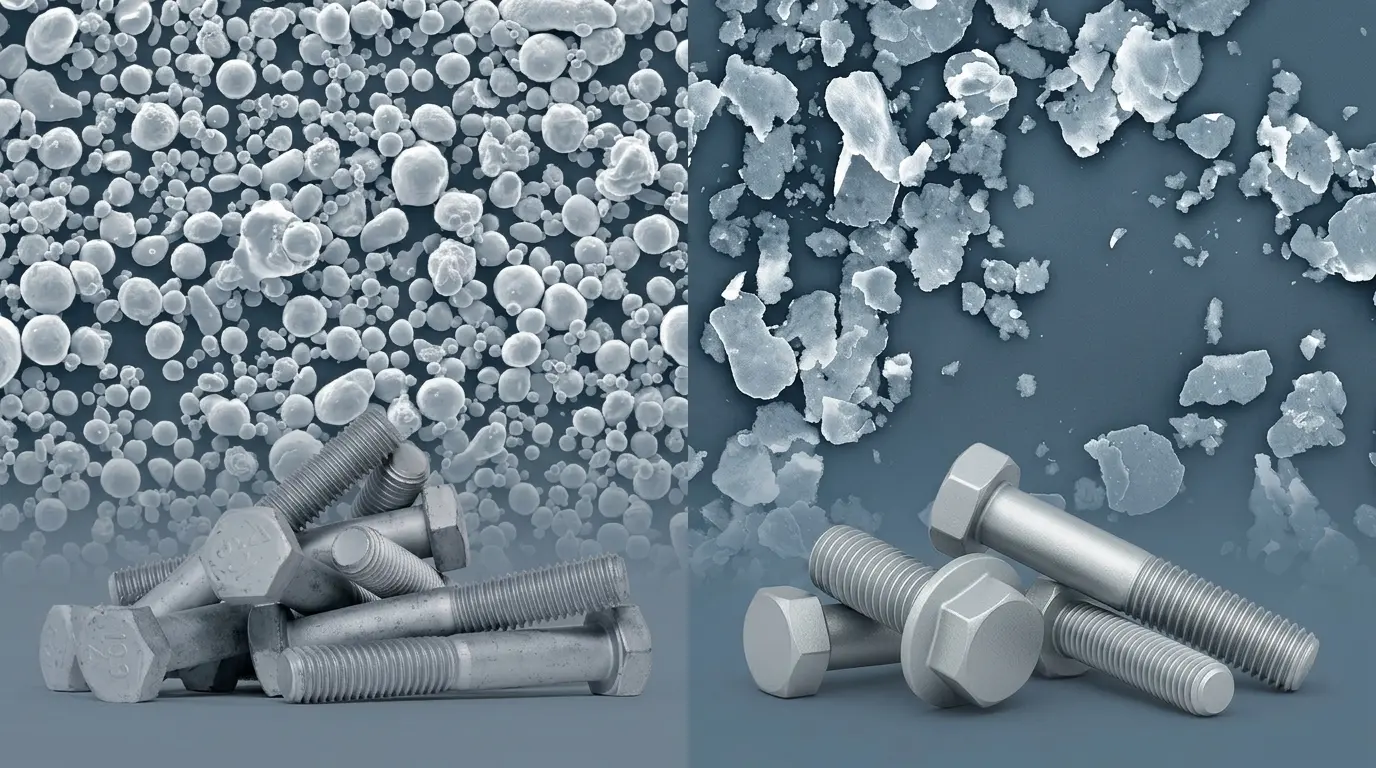

Aluminium and its alloys are widely used across industries thanks to their lightweight, corrosion resistance, and mechanical strength. However, these metals present challenges when it comes to surface finishing. Their oxide film, alloying elements, and tendency to trap surface contaminants make adhesion difficult for both plating and powder coating.
Proper surface preparation is the foundation of successful finishing. This article outlines the best practices for preparing aluminium and aluminium alloys for plating and powder coating, including chemistry details, troubleshooting tips, and a push towards sustainable chrome-free technologies.
Surface Preparation for Plating
-
Degreasing
- Purpose: Removes oils, soils, and surface contaminants.
Why Speciality Aluminium Cleaners?
- Prevent surface darkening or unwanted etching that can occur with generic alkaline cleaners.
- Contain inhibitors that protect aluminium’s highly reactive surface during cleaning.
- Provide uniform wettability, ensuring subsequent etching and de smutting.
- Non-silicate formulations ensure that aluminium silicate deposits cannot form, avoiding patchy residues.
-
Alkaline Etching
- Purpose: Removes natural oxide and produces a smooth, matte, and uniform finish.
- Typical chemistry: NaOH (30–100 g/L) at 40–60 °C.
- Why proprietary additive-based etches?
- Avoid pitting from uncontrolled caustic attack.
- Reduce over-etching that roughens the surface and harms adhesion.
- Contain stabilisers and surfactants for controlled etch rates and rinsability.
- Control: Time and temperature must be carefully balanced.
-
Acid De smut (Deoxidizing)
- Purpose: Removes insoluble residues (Cu, Fe, Si intermetallic) left after etching.
- Chemistry options:
- Nitric acid (25–50%) – standard.
- Nitric + Fluoride blends for high-Si alloys.
- Sulfuric–ferric mixtures – aerospace alloy grade processing.
- Control:
- Incomplete de-smutting → leftover smut stays → leads to poor adhesion.
- Over-de smutting → attacks aluminium → weak substrate.
-
Zincate Process
- Purpose: Aluminium cannot be plated directly due to rapid oxide reformation; zincate provides a thin zinc film for adhesion.
- Mechanism: Aluminium dissolves slightly in alkaline zincate, while Zn²⁺ reduces to form a uniform zinc film.
- Typical bath composition:
- NaOH: 100–200 g/L
- ZnO: 10–25 g/L
Recommendation – Proprietary Zincates
- Proprietary zincate formulations are more stable than basic prepared mixtures and are strongly recommended for consistent and reliable performance.
- Advantages of proprietary zincates:
- Greater bath stability with reduced risk of precipitation or sludge formation.
- More uniform zinc deposition with finer grain structure.
- Improved adhesion and lower risk of peeling or powdery films.
- Extended bath life, reducing downtime and maintenance costs.
Double Zincate (Standard Practice):
- Apply first zincate film.
- Strip in 50% nitric acid.
- Apply second zincate film.
- Produces a fine-grained, adherent film with fewer defects.
Optional Triple Zincate:
- For critical applications (aerospace, high-strength alloys), a third zincating cycle produces an even more compact and adherent film.
Zincate Troubleshooting Guide
| Problem | Likely Cause | Corrective Action |
| Powdery / non-adherent zinc film | Over-concentrated bath; poor NaOH/ZnO ratio | Rebalance chemistry; maintain stabilisers |
| Patchy zinc coverage | Incomplete desmutting; residual oxides | Improve desmutting; check acid strength |
| Excessive zinc build-up | Over-long immersion | Shorten dip (30–90 sec typical per cycle) |
| Poor adhesion to nickel layer | Zinc film too thick, porous, or contaminated | Control zincate thickness; use double/triple zincate |
| Pitting visible under zinc film | Aggressive caustic etching; no inhibitors | Switch to proprietary additive-based etch |
Final plating sequence: Degreasing → Alkaline Etch → Acid Desmut → Zincate (Double/Triple) → Electroplating (nickel, copper, etc.).
Surface Preparation for Powder Coating
-
Degreasing
- Purpose: Removes oils and shop soils.
- Methods:
- Heavily soiled parts: Strong alkaline degreasers or solvent cleaning.
- Light soils: Combined degreaser–cum–acid desmut formulations for efficiency.
- Why it matters: Even traces of oil can cause fish-eyes, pinholes, or delamination during curing.
-
Desmutting
- Purpose: Removes residual oxides and insoluble alloying elements.
- Chemistry: Acid-based systems (nitric, sulfuric, or proprietary blends).
- Why it matters: Inadequate desmutting leads to patchy adhesion and poor corrosion resistance.
-
Conversion Coating
- Purpose: Provides a corrosion-resistant, chemically active layer that improves adhesion and durability.
- Options:
- Hexavalent Chromating – Excellent protection, but highly toxic and restricted under RoHS/REACH.
- Trivalent Chromating – Safer, compliant, widely used replacement.
- Chrome-Free Systems – Zirconium, titanium, or silane-based treatments offering eco-friendly, multi-metal finishing.
Note on Chrome-Free Systems
Chrome-free conversion coatings are increasingly popular because they:
- Comply with RoHS, REACH, WEEE, and automotive OEM standards.
- Deliver corrosion resistance comparable to or better than chromates.
- Enable multi-metal compatibility (mild steel, galvanized steel, aluminium, and alloys) with a single solution.
- Reduce waste disposal costs and improve environmental and workplace safety.
Pretreatment Troubleshooting Guide
| Problem | Likely Cause | Corrective Action |
| Weak powder adhesion | Incomplete degreasing; residual oils | Enhance degreasing process; increase time/temperature |
| White spots / blisters under coating | Inadequate desmutting; trapped oxides | Improve acid desmut; refresh bath |
| Uneven or patchy coating | Poor conversion coating coverage | Maintain bath chemistry; ensure uniform rinsing |
| Corrosion creep at edges | Weak or inconsistent conversion layer | Switch to trivalent or chrome-free with better edge coverage |
| Coating failure on multi-metal assemblies | Using single-metal pretreatment | Use chrome-free system for multi-metal compatibility |
Comparison of Conversion Coating Systems
| System | Corrosion Resistance | Environmental Compliance | Multi-Metal Use | Application Notes |
| Hexavalent Chromate | Excellent (1000+ hrs SST) | ❌ Restricted (RoHS/REACH) | Aluminium only | High performance but toxic; expensive waste treatment. |
| Trivalent Chromate | Very good (500–1000 hrs SST) | ✅ Compliant | Mainly aluminium | Widely adopted, durable, proven alternative. |
| Chrome-Free (Zr/Ti/Silane) | Very good to excellent (500–1200 hrs SST) | ✅ Fully compliant | ✅ Mild steel, galvanized steel, aluminium & alloys | Eco-friendly, multi-substrate solution; growing in automotive and architectural markets. |
Conclusion
- For plating, speciality aluminium cleaners and additive-controlled alkaline etches prevent pitting and over-etching, while desmutting ensures a clean surface. Zincating — typically double, and sometimes triple — provides the critical adhesion layer for electroplated coatings.
- In powder coating, long-lasting durability begins with proper degreasing, thorough desmutting, and effective conversion coating.While hexavalent chromates once dominated, industries are now moving towards trivalent and chrome-free systems that deliver performance with full environmental compliance.
By combining the correct chemistry, process control, and expertise from leading chemical companies in UAE, manufacturers can achieve consistent, high-performance, and sustainable finishes on aluminium and aluminium alloys — whether for functional plating or decorative and protective powder coatings.